


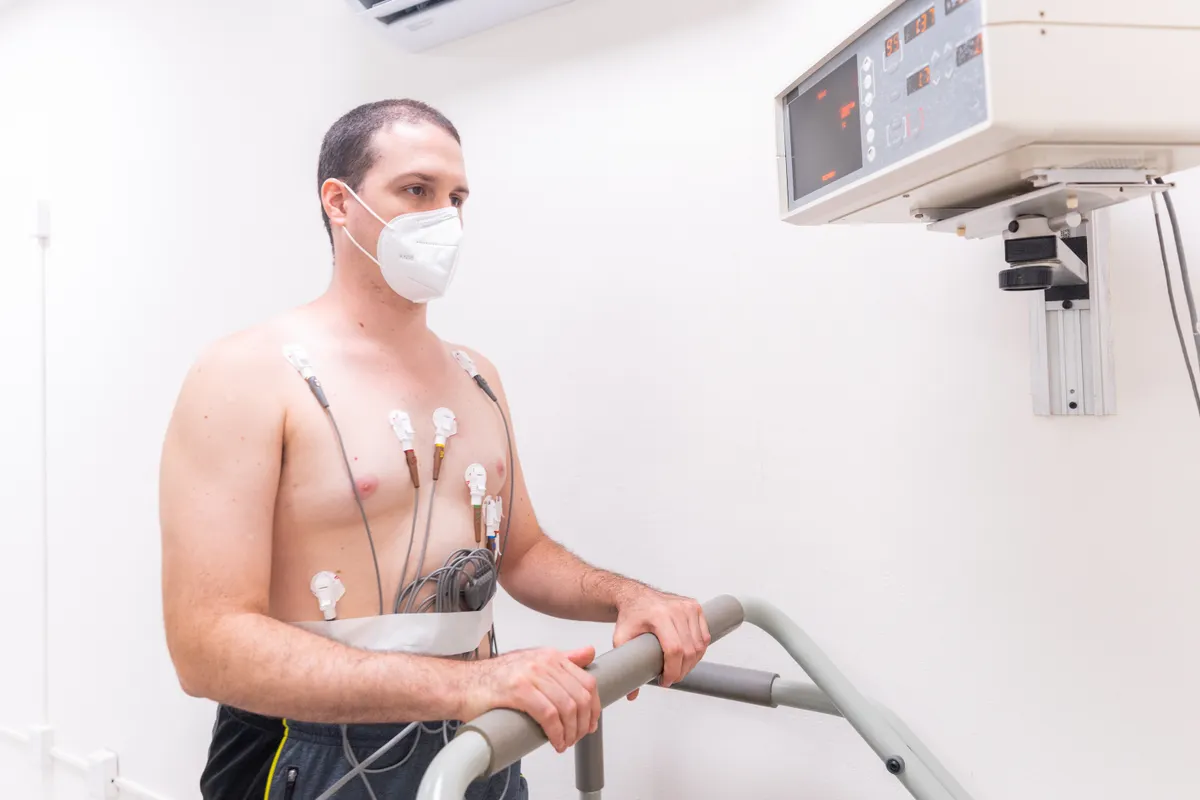
Milos Rasic has published an open-source heart rate monitor, and the open-source heart rate monitor design is straightforward enough that it deserves a proper look. The core signal acquisition is handled by an AD8232, a dedicated single-lead heart rate monitor front-end, while radio duties fall to a Seeed Studio XIAO ESP32 board, which pushes captured data out over Bluetooth to an external logger or display.
Power comes from a single 3.7 V lithium cell, with a boost converter stepping the rail up to 5 V for the rest of the circuit. Rasic has kept the design lean by omitting a charge controller entirely, which does mean the user has to find their own way to top off the cell, but it also keeps the component count and complexity low. That is a reasonable trade-off for an open-hardware project where the point is legibility as much as finished polish.
Arduino IDE and the Open-Source Heart Rate Monitor Stack
Software is loaded through the Arduino IDE, which is a sensible choice for a project aimed at tinkerers. Because the IDE supports a wide range of Espressif targets, other ESP32 variants could slot in with modest modification to the codebase. The Bluetooth stack, the signal processing, and the board support are all community-maintained territory at that point, which lowers the barrier for anyone who wants to adapt the design to different form factors or radio requirements.
The manufactured equivalents of this kind of chest-strap monitor are cheap enough to pick up without much thought, but that accessibility is precisely why an open-source version matters. When the hardware and firmware are readable, users can verify what the device is actually doing with their physiological data, modify the signal chain, or port the whole thing to a different microcontroller. A closed commercial unit offers none of that.
Rasic’s Broader Work on Open Medical Devices
The heart rate monitor sits inside a wider body of work. According to Hackaday, Rasic has developed a device capable of recording, storing, and analysing data from an arm cuff, stethoscope, electrocardiograph (ECG), and pulse sensor, pulling together several measurement modalities that are usually handled by separate, closed instruments.
That ambition carries through into his conference work. Earlier this year at Hackaday Europe, Rasic gave a talk on blood pressure monitoring, and specifically on the digital oscillometric analysis that underpins cheap electronic blood pressure monitors. As Hackaday’s write-up of the talk makes clear, the question he is really asking is whether those inexpensive monitors are giving users accurate readings, and what the algorithm behind the oscillometric method is actually doing to produce a number. It is a sharp angle: the monitors are everywhere, the methodology inside them is largely invisible, and the gap between those two facts is exactly where open hardware can do useful work.
Oscillometric blood pressure measurement works by inflating a cuff and then detecting oscillations in cuff pressure as the artery opens and closes. The peak of those oscillations corresponds to mean arterial pressure, and systolic and diastolic values are derived algorithmically from that peak. The specific algorithm each manufacturer uses is, in most cases, proprietary, which means the user has no way to audit the derivation. Rasic’s interest in opening up that process fits the same pattern as the chest-strap monitor: make the signal chain readable, and you give the user some agency over a device that is otherwise a black box.
For anyone wanting to build the chest-strap monitor themselves, the Arduino IDE entry point keeps the firmware accessible, and the AD8232 is a well-documented part with thorough application notes covering electrode placement, lead-off detection, and filter configuration. Rasic’s design is a reasonable starting point for anyone who wants a wearable ECG front-end they can actually inspect and modify.
Rasic’s Hackaday Europe talk on blood pressure monitoring is available to watch now for anyone curious about the oscillometric analysis behind the devices sitting in medicine cabinets across the country.
