


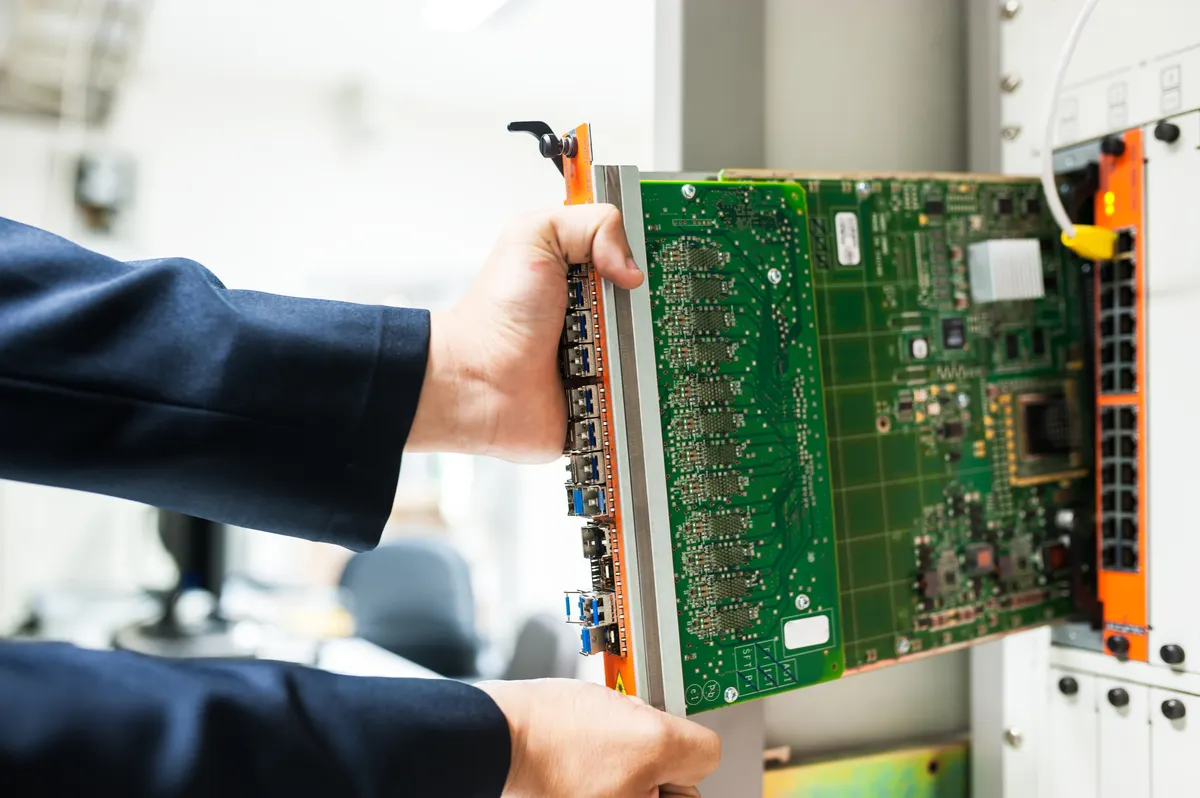
A Ubiquiti 16-port PoE switch repair that could have ended in the skip instead came in at roughly £5 in parts, after [Buy It Fix It] rescued a £300 switch and traced catastrophic damage on four ports back to a single blown Broadcom controller chip and a handful of dead MOSFETs.
The switch, a 16-Ethernet-port, 2-SFP-port Ubiquiti unit, arrived with four ports and their associated Power over Ethernet circuitry in a thoroughly sorry state. Opening the lid made the cause immediately apparent: one Broadcom BCM5911 controller chip had a chunk visibly missing from its plastic packaging. Probing the surrounding components confirmed that multiple MOSFETs and at least one diode had shorted out completely. Whatever connected Ethernet device had suffered the original fault, it sent a destructive surge back through the switch that nearly took the whole thing with it.
Tracking Down a Discontinued Broadcom IC
The BCM5911 is not a part you will find sitting in a distributor’s warehouse. Digikey and Mouser no longer carry it, which means the usual route of ordering a known-good component from a reputable distributor was closed off from the start. That kind of sourcing dead end is a familiar frustration for anyone repairing equipment that sits a few years past its component-availability window.
The solution was AliExpress, where the BCM5911 was available for £1.84. The caveat that always travels with AliExpress ICs applies here: the part could be genuine surplus, a factory reject, a pulled component, or an outright counterfeit. In this instance, it turned out to be a legitimate Broadcom chip. That is genuinely the best-case outcome when sourcing an obscure controller from the grey market, and not one you can count on every time.
Ubiquiti 16-Port PoE Switch Repair: Four Ports Back From the Dead
With the replacement BCM5911 fitted and the shorted MOSFETs and diode swapped out, all four affected ports came back to life. The proof of the pudding was a PoE camera powering up correctly from one of the restored ports, which is about as clean a functional test as you could ask for on a switch with PoE circuitry. The remaining twelve ports had survived the original event intact, so the repaired unit is now a fully working 16-port switch again.
Total outlay on components came to around £5, with the bulk of that being the ancillary passive and active components rather than the BCM5911 itself. The time invested in diagnosis, sourcing, and rework is a separate matter, but on a switch that was heading for disposal, the financial case for attempting the repair was never really in doubt.
What makes this repair worth paying attention to is the sourcing challenge as much as the soldering. Network switches in this class use application-specific ICs that simply do not appear on mainstream distributor catalogues once they age out of production. The BCM5911 is a PoE controller, and Broadcom’s product lines move on; the switch market moves on with them. Anyone holding a faulty unit of similar vintage will face exactly the same grey-market lottery that [Buy It Fix It] navigated here.
The broader lesson, if you are sitting on a failed managed switch that a supplier quoted an eye-watering repair charge for, is that the failure mode is often a single controller IC and a few discrete components rather than wholesale board damage. Lid off, careful probing, a part number from the offending chip, and a search beyond the mainstream catalogues can turn a binned £300 switch into a working one for the price of a sandwich.
