


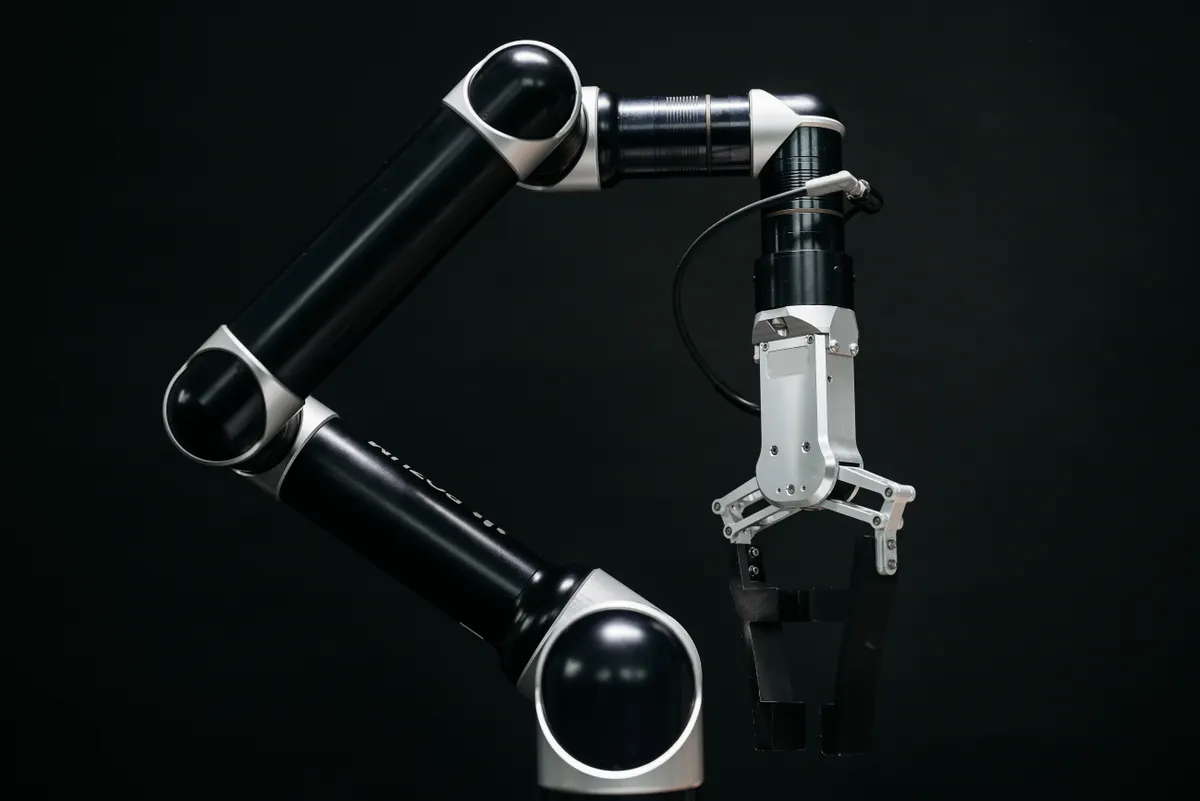
The MegCell Pulse guitar robot is a six-year labour of love from Bruce, a New Zealand engineer who set out to do something that still sounds faintly impossible: build two robotic arms that work together to play an acoustic guitar the way a pair of human hands would. You feed it digital tablature, one robot frets, the other plucks with six individual plectrums, and out comes real, analogue sound from a real, physical instrument.
How the MegCell Pulse Guitar Robot Actually Works
The system is built around gears, magnetic actuators, and articulated arms, all housed inside a 3D-printed structure. The division of labour between the two robots mirrors the natural split between a guitarist’s fretting hand and strumming hand, making the MegCell Pulse guitar robot feel less like a novelty and more like a genuine attempt to replicate human playing technique in mechanical form.
There are limitations, as there always are with first-generation mechanical systems. The robots cannot traverse the full length of the fretboard, and sliding between frets is not something they can manage. Within those constraints, though, the results in Bruce’s demo videos are genuinely arresting. Digital tablature in, acoustic guitar out, no human hands involved.
According to TechEBlog, Bruce came to this project as an engineer rather than a musician, drawing on a background that spans naval engineering, composite work, CAD drawings, and automation. That breadth of discipline shows in the design: the 3D-printed chassis, the actuator layout, the software layer that translates tab notation into physical movement. Six years of iterative engineering work produced something that no off-the-shelf robotics kit was ever going to give him.
Six Years in the Making, Now Available via Kickstarter
Bruce has launched a Kickstarter campaign for the MegCell Pulse, though the model here is not the usual one. You cannot purchase an assembled unit. Instead, you build it yourself, which means owning a 3D printer and being willing to put the hours in. For anyone comfortable with that commitment, the most expensive supporting tier sits at $100, which covers the complete digital package: 3D print files, an assembly guide, the control software, and a full parts list.
It is a modestly-priced entry point for what amounts to a bespoke robotic guitar player attached to your own acoustic instrument. The Kickstarter is described as modestly-goaled, which fits the spirit of the project: this is not a mass-market product pitch, it is a maker sharing six years of hard-won engineering with whoever has the patience and the printer to build one.
The MegCell Pulse guitar robot sits in a lineage of machines that have tried to mechanise musical performance. Long-time readers will remember Animusic, the computer-animated music video series that conjured up fantastical instrument-playing robots entirely in CGI. The MegCell Pulse is doing something harder: making it physical, making it real, and making it reproducible by anyone with access to a printer and Bruce’s plans.
Robots playing guitars is not a new concept in the maker community, but the twin-arm architecture here, with its deliberate split between fretting and plucking functions, is a more faithful mechanical translation of actual guitar technique than most previous attempts. The six individual plectrums on the strumming arm give it a degree of string-selectivity that simpler single-actuator designs cannot match.
For $100 and the cost of whatever parts the list specifies, you could have a MegCell Pulse guitar robot clamped to your acoustic guitar, working through tabs while you make a cup of tea. Whether Bruce’s naval engineering background was the secret ingredient that kept this project alive across six years of iteration is hard to say, but it produced something that looks unlike anything else in the hobbyist robotics space right now. The Kickstarter campaign is live.
