


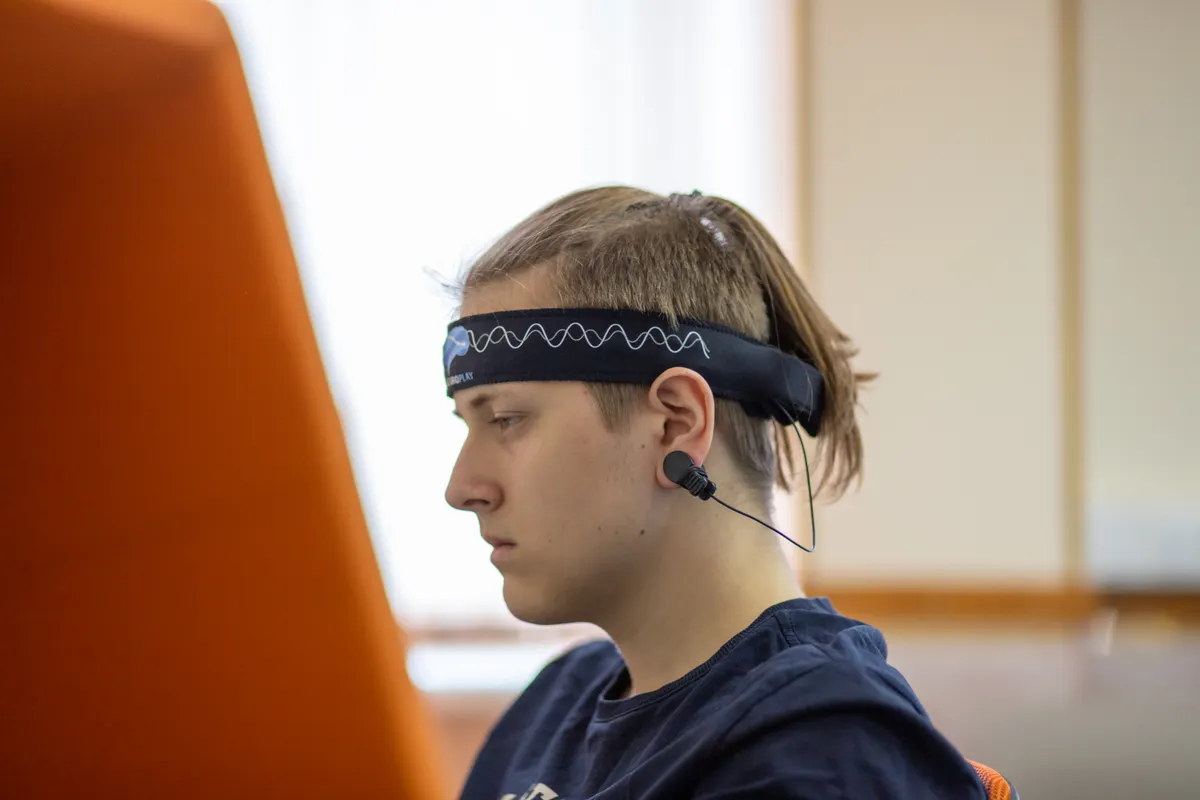
The Octopus 16 EEG gaming project from Hackaday is exactly the sort of open hardware experiment that makes you wish the demo scene had taken brain-computer interfaces seriously decades ago: a compact, wireless, sixteen-electrode headset that reads your brainwaves and feeds them into game environments, all without drilling anything into your skull.
The work comes from Ildar Rakhmatulin and Youssef El Abbass, who set out to build a non-invasive electroencephalogram (EEG) interface with an eye firmly on gaming applications. The result is the Octopus 16, named for its sixteen EEG electrodes, which are arranged alongside a common reference and ground into a single, compact package. The contacts themselves are pogo pins, pressed together into a coin-sized cluster and strapped directly against the scalp. No gel, no fuss, no neurosurgeon required.
Inside the Octopus 16 EEG Hardware
Getting clean brainwave data out of a dry-contact headset is no trivial matter, and the signal chain here is worth examining. Two Texas Instruments ADS131M08 analogue-to-digital converters handle the acquisition, each providing eight channels for a total of sixteen. Both run at 24-bit resolution, which gives the system enough dynamic range to resolve the relatively faint electrical activity the brain produces against the background noise that will inevitably creep in from a dry-electrode setup worn on the go.
An ESP32 microcontroller sits behind the ADCs, collecting their output and pushing it out over Bluetooth Low Energy to a connected host machine. According to CNX Software, the Octopus 16 is specifically designed as a wireless biosignal HID device for the XIAO ESP32-S3 board, which gives you a sense of the project’s scope: this is self-contained, battery-friendly hardware aimed at practical, portable use rather than a tethered laboratory bench setup.
The whole rig is designed to work with the PiEEG software platform, which handles the incoming data stream on the host side. That combination of off-the-shelf ADC silicon, an ESP32 for wireless duty, and an established EEG software framework keeps the barrier to entry relatively low for anyone wanting to experiment seriously with biosignal acquisition.
Octopus 16 EEG Gaming Experiments and What They Show
The team have already put the hardware through its paces in a gaming context, using the EEG signals to detect a wearer’s focus state in real time and routing that output into simple game environments. Detecting focus, broadly, distinguishing between relaxed and attentive mental states by looking at alpha and beta wave activity, is one of the more tractable problems in consumer EEG, and it is a reasonable starting point for a hardware platform at this stage of development.
The result is not entirely unlike the old Force Trainer toy, which used a single-channel EEG to control a ball hovering in a tube by concentration alone. The Force Trainer was never going to run Doom. What separates a project like the Octopus 16 from a novelty toy is the sixteen-channel, 24-bit signal capture, the open hardware and software stack, and the genuine scope for expansion into more nuanced classification tasks as the team’s understanding of the signal quality deepens.
Whether the noise floor from dry pogo-pin contacts at that resolution will prove good enough for more demanding brain-computer interface applications is the central practical question. Getting sixteen channels of usable EEG out of a dry-contact, portable headset is genuinely difficult, and the team themselves note that careful attention to signal quality is needed to make the most of those 24-bit ADCs.
A Budget EEG Platform Worth Watching
For anyone on the hardware side of things who has ever wanted to experiment with EEG acquisition without spending laboratory money, the Octopus 16 EEG gaming platform looks like a credible starting point. The open design, the use of widely available components, and integration with the PiEEG software ecosystem mean that someone already comfortable with ESP32 development has a realistic path from unboxing to actual brainwave data in a single session.
The project was covered by CNX Software on 2 August 2026, and the Hackaday write-up followed on 14 August 2026, bringing it to a wider audience of makers and hardware experimenters who will no doubt have plenty of questions about that signal-to-noise ratio.
