


The OVODYO icosahedron clock, designed by ekaggrat singh kalsi, tells the time by physically tumbling a pair of 3D-printed twenty-faced polyhedra, each one spinning through its faces to present the correct numeral upright to the viewer. It is one of the more spatially ambitious clock builds to appear on Hackaday.io, and the mechanical thinking behind it repays close attention.
How the OVODYO Icosahedron Clock Actually Works
Each icosahedron has numerals sunk through all twelve of its faces, and sits raised above the clock’s base on a brass support shaft. An inner drive shaft runs through the centre of that support shaft and connects to a set of bevelled gears, which spin the outer shell around two axes. Because of the geometry of how an icosahedron rotates through those two axes, only one set of numerals appears upright at any given moment, which makes reading the time straightforward despite the unconventional display.
The rotation stops are not arbitrary. According to the project page on Hackaday.io, the hour ball stops every one and a quarter rotations, which works out to 450 degrees, while the minute ball stops every quarter rotation, or 90 degrees. Those figures reflect the icosahedral geometry: the two-axis tumbling motion cycles through all twelve faces, and the stop points are calculated so the correct face locks into the readable position at each increment.
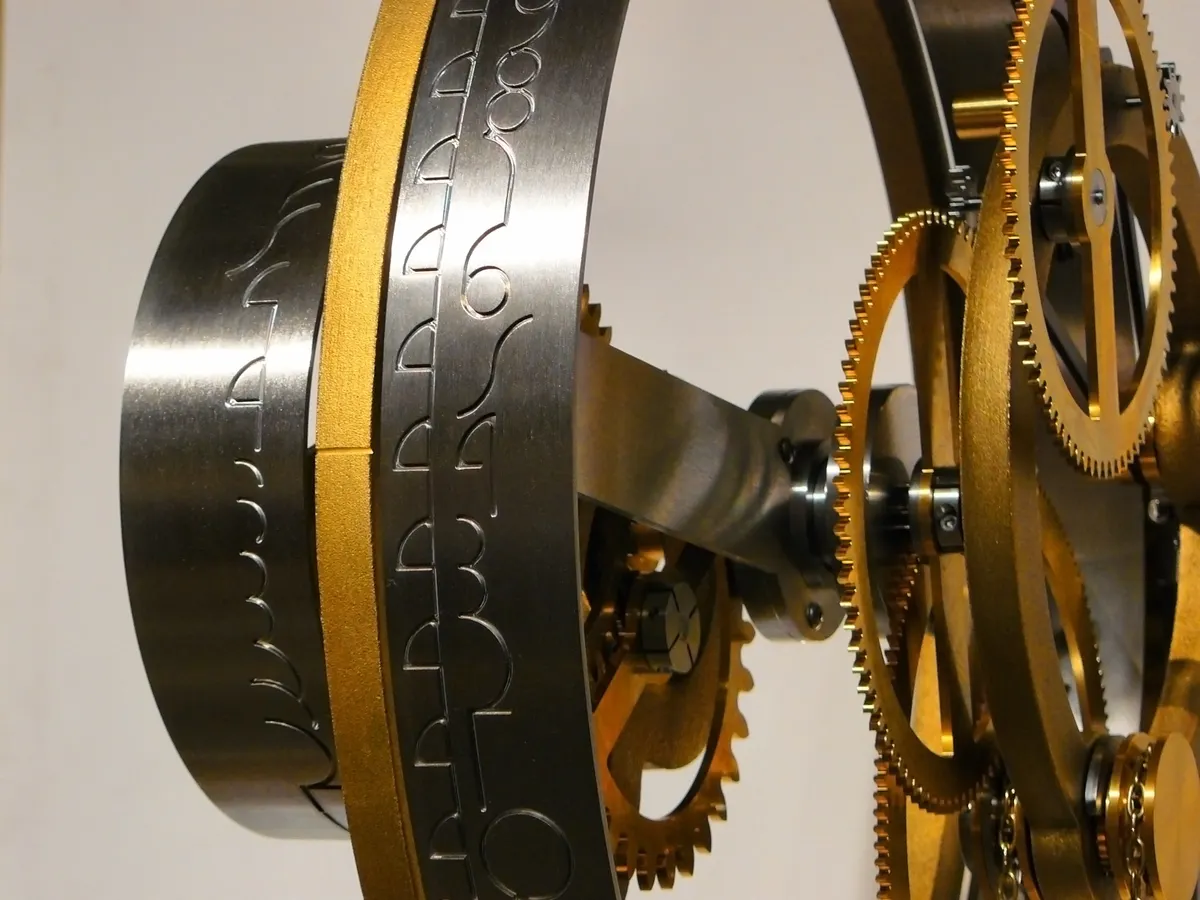
A split path around each icosahedron serves two purposes at once. It allows the outer shell to rotate freely around the support shaft, and it also shows off the internal gearing to anyone looking on. It is the kind of detail that distinguishes a carefully considered build from one that simply works.
Electronics, LEDs and the Minutes Problem
On the control side, an ATmega8 microcontroller drives a pair of stepper motors via DRV8833 motor drivers. A hall effect sensor detects each indicator’s position, giving the firmware a reliable home reference without any mechanical end-stop. Because the minute icosahedron only advances in five-minute steps (there are twelve faces, and twelve into sixty divides neatly) the display cannot show the exact minute from the ball alone.
Kalsi’s solution is an LED strip built into the base. Six RGB LEDs in the centre of the clock light up to indicate the precise minute within each five-minute window, bridging the gap between the mechanical counter’s resolution and the full sixty-minute range a clock needs. It is an elegant compromise: the icosahedra do the heavy lifting visually, and the LEDs handle the detail work quietly underneath.
The combination of stepper motors, hall effect sensing, and a small AVR microcontroller keeps the control architecture legible. The ATmega8 is not a high-powered choice, but it does not need to be. Driving two steppers on a known schedule, reading one sensor per axis, and updating six LEDs sits comfortably within its capabilities.
The Maker Behind the Machine
Ekaggrat singh kalsi is an architect based in Beijing who graduated from CEPT in Ahmedabad, India, according to his profile on Make: DIY Projects and Ideas for Makers. That architectural background shows in the OVODYO’s proportions and in the deliberate choice to expose the gearing through the split-path surround rather than conceal it.
The OVODYO is not his first clock to attract attention. His previous work includes a dynamic chain-link sculpture clock, a clock built around hair ties, and a mechanical seven-segment display, each one exploring a different way to represent digits in physical form. Read together, they trace a consistent interest in mechanisms that make the act of reading a number into something worth watching.
The full project documentation, including the rotation geometry and wiring details, is available on Hackaday. Anyone with a 3D printer, a handful of stepper drivers, and a tolerance for bevelled gear calculations will find the build files worth a close look.
