

Close Menu
Retro ComputersRetro Computers
    Facebook X (Twitter)
    • Privacy policy
    • Terms and Conditions
    Facebook X (Twitter)
    Retro ComputersRetro Computers
    • Home
    • About Us
    • News
    • Finance
    • Health
    • Others
      • Politics
      • Entertainment
      • Lifestyle
      • Property
      • Technology
      • Travel
      • World
    • Contact us
    Subscribe
    Retro ComputersRetro Computers
    You are at:Home » FV-1 DSP Emulator Lets You Test Guitar Pedal Effects Without Touching the Hardware
    Technology

    FV-1 DSP Emulator Lets You Test Guitar Pedal Effects Without Touching the Hardware

    Mark SpicerBy Mark SpicerOctober 4, 2026No Comments3 Mins Read
    Facebook Twitter Pinterest Telegram LinkedIn Tumblr Email Reddit
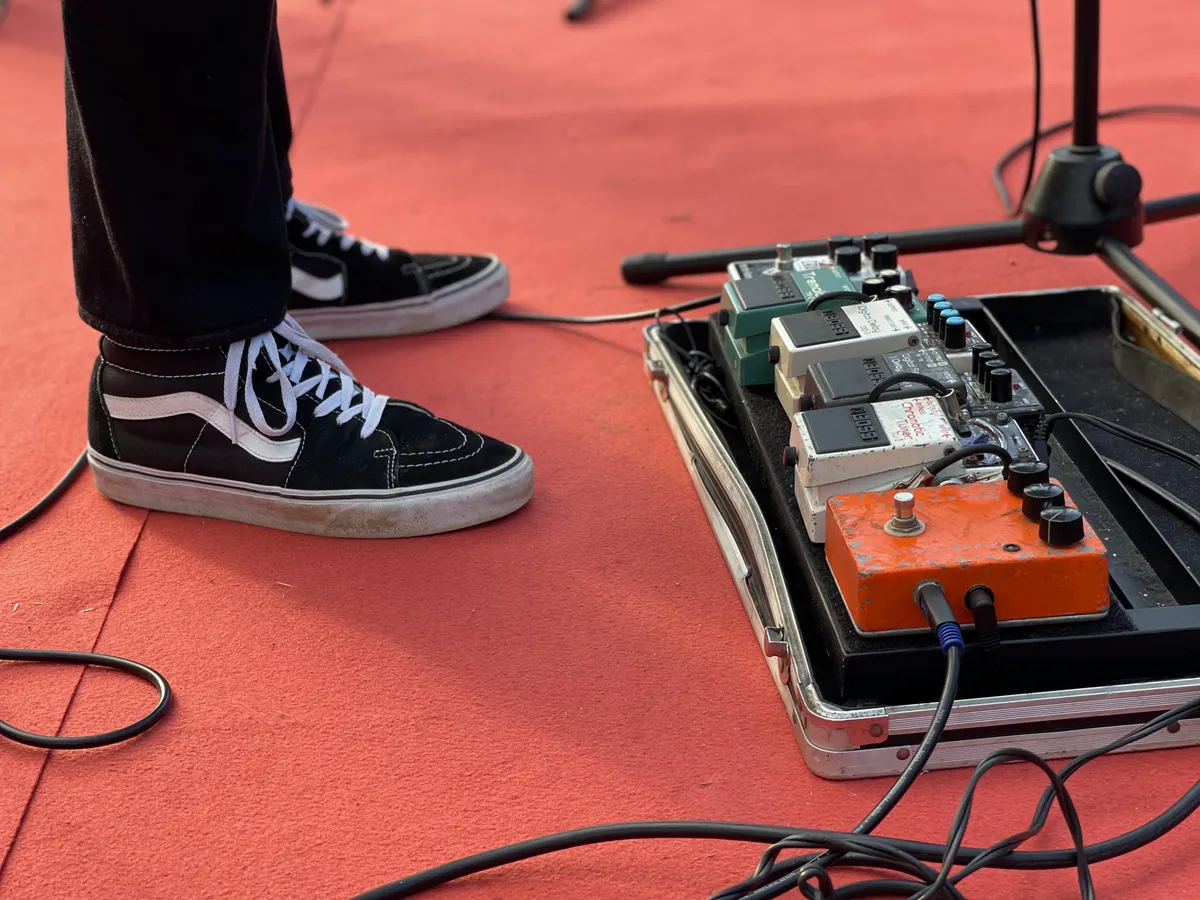
    FV-1 DSP emulator
    Share
    Facebook Twitter LinkedIn Pinterest WhatsApp Email

    A developer known as [adamjvr], also referred to as [avr], has released an FV-1 DSP emulator for PC that brings the Spin Semiconductors FV-1 digital signal processor into software, letting audio effects developers write and test code without ever touching physical hardware until they are ready. The project targets the fairly niche but deeply committed world of guitar pedal and audio effects design, and it is available for Linux, macOS and Windows as open-source code on GitHub under the Mozilla Public License.

    Why an FV-1 DSP Emulator Changes the Development Workflow

    The case for emulation comes down to friction and flash memory. Without a PC-based simulation, the loop goes: write code, flash it to the board, listen, repeat. That middle step costs time, and it also costs write cycles, because the board’s memory supports only a limited number of flashes before it degrades. An emulator collapses the cycle to code and test, with flashing saved for the moment the simulated chip is actually producing the sounds you want.

    That matters more with the FV-1 than it might with a general-purpose microcontroller, because the programming model is unusual. According to Spin Semiconductors, the FV-1 was designed specifically for audio effects applications, built to behave for all practical purposes as an analogue part running at 33.55 MHz. The instruction set is correspondingly focused: rather than a wide-purpose processor, this chip does one thing and does it in a very particular way.

    For the raw numbers, The Gear Page community puts the FV-1’s capacity at 3,500 instructions running at 200 MHz, which gives you a sense of its tight but purposeful architecture. You are not getting a general DSP that happens to handle audio. You are getting a chip that thinks entirely in audio effects terms, which is precisely why developing for it has its own learning curve.

    EEPROM Programming and the SpinAsm Toolchain

    Understanding the hardware context makes the emulator’s value clearer still. As Electric Canary explains, programs reach the FV-1 via an EEPROM. You can write up to eight separate programs onto a single EEPROM and connect it directly to the DSP, which means a finished pedal can carry a small library of effect variations selectable at runtime. That is a genuinely elegant system, but it also means every round-trip through the flash-and-test cycle is burning one of those write operations.

    Spin Semiconductors themselves produced a free IDE for writing effects code called SpinAsm, though it runs on Windows only. The existence of SpinAsm is a good indicator of how self-contained this little ecosystem is: it has its own assembler language, its own philosophy of operation, and now, thanks to [adamjvr], its own PC-based FV-1 DSP emulator to sit alongside the official tooling. Developers on Linux and macOS who found SpinAsm out of reach now have a cross-platform route into the workflow.

    The open-source release is distributed under the Mozilla Public License, which is not the most common choice for a project of this kind, but it is a legitimate and permissive option. The fact that it exists at all, cross-platform and freely available, is what most developers in this space will care about.

    For anyone already building effects hardware, the pitch is straightforward: iterate quickly in software, confirm the DSP behaviour matches what you want, then flash the EEPROM once with confidence. The project’s GitHub repository carries releases for all three platforms, ready to download.

    Post Views: 8
    Share. Facebook Twitter Pinterest LinkedIn Reddit WhatsApp Telegram Email
    Previous ArticleOSHintosh Open Source Mac Brings the 512K Back as a Modern PCB
    Mark Spicer

    Mark Spicer has been working in and writing about technology for the better part of two decades. He started as a systems administrator at a financial services firm, moved into IT consulting, and spent six years at a fintech building payment infrastructure before going freelance. He writes about fintech, enterprise software, cybersecurity, and the technology decisions that companies make badly and expensively. He has migrated enough legacy systems to know that 'digital transformation' usually means 'we should have done this five years ago'. Mark lives in Reading. He still builds PCs for fun and considers the command line a perfectly good user interface.

    Related Posts

    OSHintosh Open Source Mac Brings the 512K Back as a Modern PCB

    October 4, 2026

    Hackaday Supercon 2026 Tickets on Sale as Tenth Edition Moves to Bigger Venue

    October 3, 2026

    LAGEOS-1 Laser Ranging Satellite: The Disco-Ball With No Electronics Still Orbiting After Nearly 50 Years

    October 3, 2026
    Leave A Reply Cancel Reply

    Categories
    • Automation
    • Automotive
    • Awards
    • Books & Publishing
    • Business
    • Celebrities
    • Community Development
    • Digital Marketing
    • Education
    • Electronics
    • Energy & Sustainability
    • Entertainment
    • Environment
    • Event
    • Fashion & Beauty
    • Featured
    • Finance
    • Food & Drink
    • gaming
    • Health
    • law & Policy
    • Lifestyle
    • Media & Entertainment
    • News
    • Politics
    • Property
    • Science
    • Sports
    • Technology
    • Telecom
    • Transport & Vehicle
    • Travel
    • Vehicle
    • World

    FV-1 DSP Emulator Lets You Test Guitar Pedal Effects Without Touching the Hardware

    OSHintosh Open Source Mac Brings the 512K Back as a Modern PCB

    Hackaday Supercon 2026 Tickets on Sale as Tenth Edition Moves to Bigger Venue

    LAGEOS-1 Laser Ranging Satellite: The Disco-Ball With No Electronics Still Orbiting After Nearly 50 Years

    Delta iPhone Duo DS Emulation Support Confirmed by Lead Developer

    Stay informed with Retro computers – your source for reliable news and expert insights. Explore our site for the latest stories and updates.

    Email Us: info@brittanybathgate.co.uk
    Contact: +1-320-0123-451

    Pages
    • About Us
    • Contact us
    • Privacy policy
    • Terms and Conditions

    Subscribe to Updates

    Get the latest creative news from FooBar about art, design and business.

    © 2026 Retro Computers

    Type above and press Enter to search. Press Esc to cancel.