


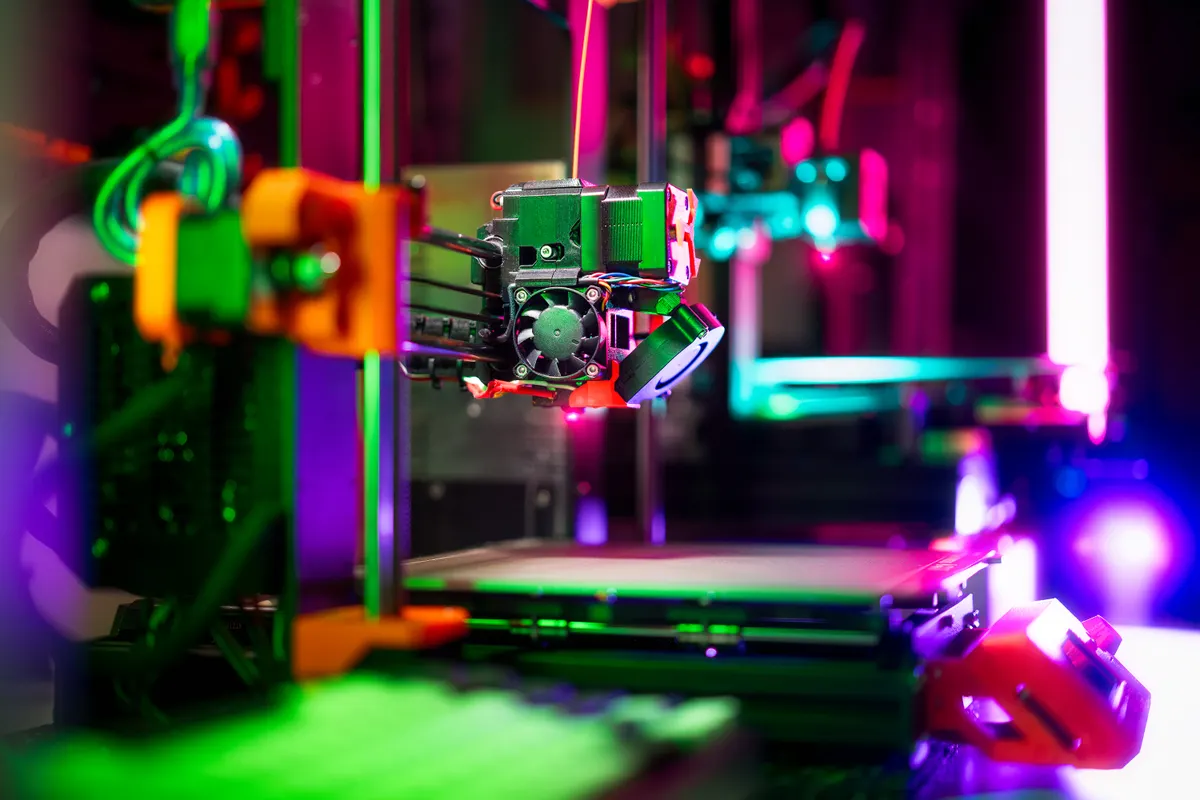
The ongoing effort to use 10 W blue lasers for laser smoothing 3D prints has not yet reached its goals, but the careful, public documentation of every false start and confounding problem may turn out to be more valuable than a clean success video ever could have been. That is the argument put forward in the Hackaday newsletter, and having watched the two-part video series by the creator known as [I changed a thing], it is a hard case to argue with.
The project sets out to post-process FDM prints with a laser, melting the visible layer lines left by the printing process into a smoother surface. On paper it sounds straightforward enough. In practice, the software required to drive the laser-augmented machine turns out to demand solutions to a set of geometric problems that standard FDM path planning never has to confront.
Why Laser Smoothing 3D Prints Is Harder Than It Looks
FDM printers work in flatland. The slicer divides a model into horizontal layers, the print head moves in two dimensions per layer, and the question of whether the nozzle will crash into previously printed material simply does not arise. That constraint is what makes FDM so capable of producing interlocking knots, hinges, and even full sections of chain mail: as long as you go one layer at a time, the geometry largely takes care of itself.
Laser smoothing breaks that comfortable arrangement. To blend two or more layers into each other, the laser path must move in genuine three-dimensional space. Suddenly the system has to reason about collisions, about obstructions, about whether the beam can reach into a narrow valley without striking a surrounding wall. These are not trivial problems, and [I changed a thing] does not pretend otherwise. Each attempt at writing the control software surfaces a new complication, and each complication is laid out methodically in the videos rather than quietly edited out.
The result, as the newsletter puts it, is something close to nerd sniping: the kind of well-described, unsolved problem that makes a certain type of person stop what they are doing and start thinking about how they would tackle it. A polished success video demonstrates that a thing can be done. A careful failure analysis demonstrates what must be overcome, and that is often the more useful document.
The Open-Source Case for Documenting Failure
There is a broader point here about how collaborative technical work actually functions. Documenting what went wrong, why it went wrong, and what constraints a future attempt will have to respect is not simply good practice for your own benefit. It is the act of lowering the barrier for the next person who wants to pick the project up.
The more thoroughly a dead end is mapped, the less time the next contributor wastes rediscovering it. In that sense, a well-written failure report is a form of generosity: it converts a private frustration into shared knowledge. As the newsletter frames it, the more thought you put into how and why a project failed, the more bait you are laying out for the next interested person. That is at least part of what makes the open-source model function across projects that span years and multiple contributors.
For laser smoothing specifically, the documented obstacles, collision avoidance, beam access to recessed geometry, achieving uniform energy delivery across a curved surface, now exist as a clear brief for anyone who wants to extend the work. The project remains in progress, but its publicly recorded difficulties are already doing useful work.
The Hackaday newsletter, which has run for more than 200 consecutive weeks, carries pieces like this one every Friday: short, considered arguments drawn from the maker and open-source hardware community. If the laser-smoothing problem sounds like one you want to think about, the videos are waiting.
