


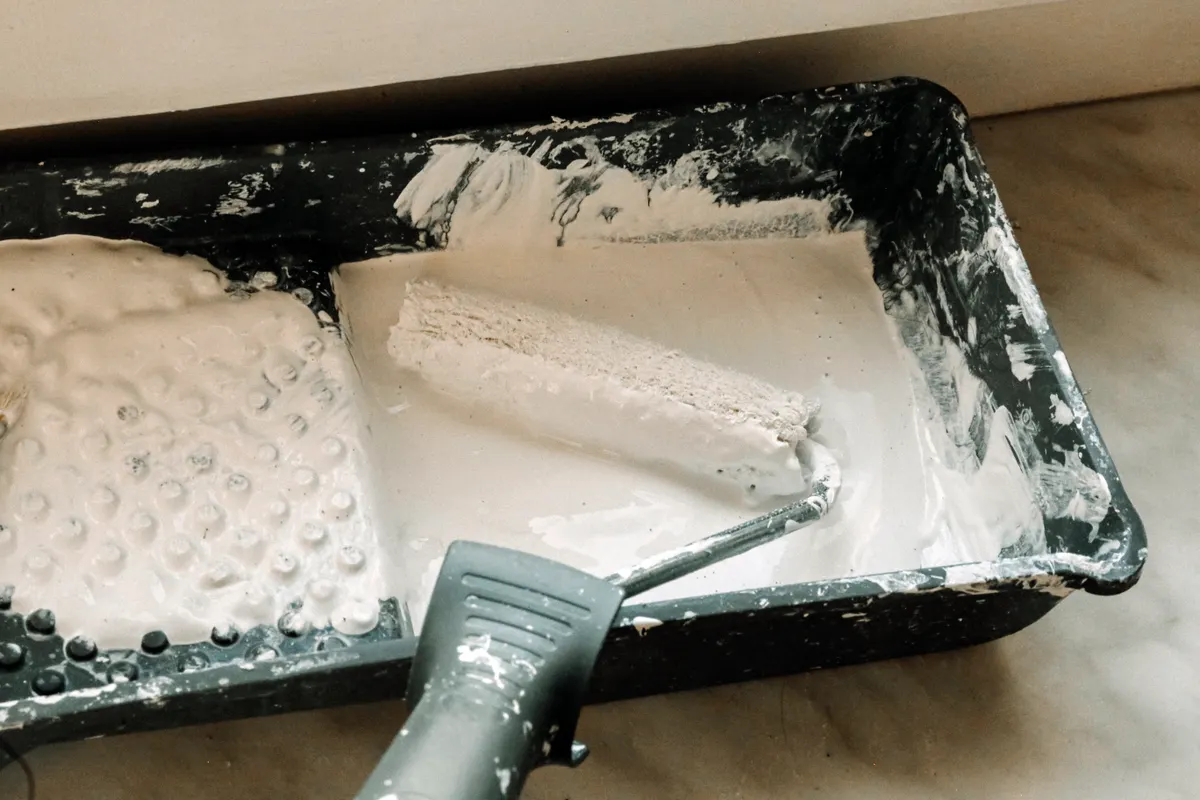
The cooling roof paint humidity problem is something that anyone outside a desert climate will want to think through carefully before reaching for the roller, as Hackaday contributor NightHawkInLight discovered after treating his shed’s tin roof with an off-the-shelf silicone-based coating.
The principle itself is straightforward and genuinely old. Paint a roof or wall white (or close enough to white) and it reflects a substantial portion of incoming solar radiation, keeping the building’s interior cooler. It works. NightHawkInLight’s shed got cooler. So far, so good.
When Cooler Air Means Wetter Air
The complication arrived in the form of indoor humidity. Michigan is not the Mojave. In a high-humidity climate, a cooler interior is also a more humid interior, because cooler air holds less moisture before it becomes saturated. NightHawkInLight found that instead of running an air conditioner for eight hours a day, the shed now required a weekly dehumidifier session to keep conditions comfortable. The energy saving was real (the dehumidifier drew fewer kWh than the air conditioner would have) but the humidity problem had simply been rerouted rather than eliminated.
This matters more than it might first appear. According to a Yahoo Finance report on Adept Materials, managing humidity can account for up to 40% of total air-conditioning energy use in humid climates. Shift the thermal load around without addressing the moisture, and the savings on one line of the energy bill may simply migrate to another.
Cooling Roof Paint Humidity Gets Worse With Sub-Ambient Coatings
NightHawkInLight did not stop at the commercial silicone coat. In a follow-up test, he compared his own DIY sub-ambient cooling paint against a commercial equivalent, and both managed to bring a sample panel down to around ambient temperature, cooler than the current silicone-based coating on the shed roof, which stays above ambient. That is a meaningful performance step forward for cooling purposes.
The humidity implication, however, follows the same logic in a more extreme direction. A roof surface at or below ambient temperature in a humid climate is a roof surface that can experience condensation. That moisture has to go somewhere, and in a tin-roofed shed it is not going to evaporate cheerfully on its own. The condensation problem that was already present at above-ambient roof temperatures would, as NightHawkInLight acknowledges, get noticeably worse if sub-ambient performance were achieved at full roof scale.
The physics here are unforgiving. The cooler the surface, the lower the dew point margin, and in a Michigan summer the dew point is rarely your friend.
Emerging Solutions in Humidity Management
The wider building-materials industry is paying attention to exactly this class of problem. Adept Materials recently launched a product called Lilypad, a humidity-regulating paint that, in controlled tests simulating a typical shower, kept peak humidity about 15% lower than standard paint. Whether a product of that type could be paired with a reflective roof coating to manage the combined thermal and moisture load is an open question, but the existence of humidity-regulating surface treatments at least suggests the two sides of the problem are being worked on in parallel.
For the moment, NightHawkInLight’s experience points to a fairly clear conclusion for anyone in a temperate or humid climate considering a cooling roof coat: the thermal benefit is real, and even at above-ambient performance levels the energy arithmetic can still work in your favour, but the dehumidification load has to be factored in from the start. Ignore it and you have not reduced your energy use, you have just changed where it goes.
The shed roof stays painted. The dehumidifier still runs once a week. That is, in its own way, a perfectly honest result from a well-conducted experiment.
