


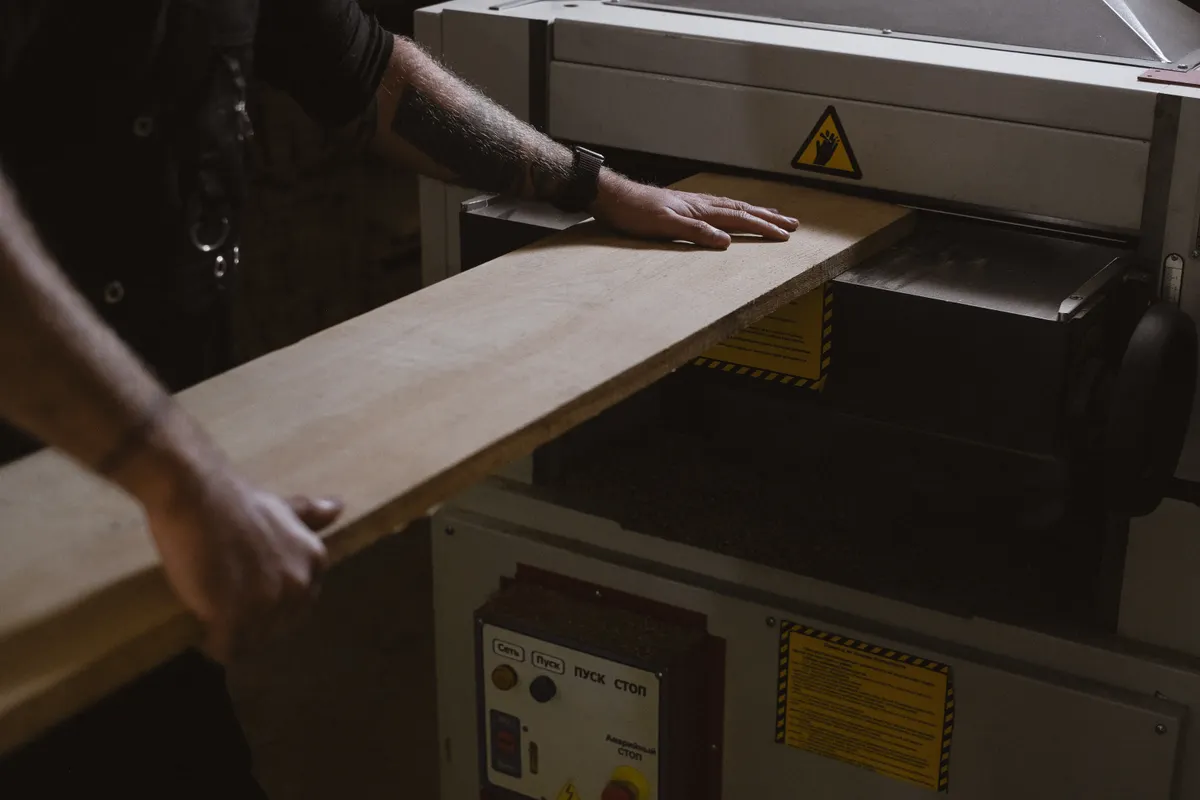
A motorised stepper system built around a DeWalt planer height adjustment wheel has evolved from a quick maintenance shortcut into a fully programmable, multi-mode planing controller, as maker Hackaday community contributor DendroLabsDev has documented in detail.
The frustration that sparked the whole project is instantly familiar to anyone who has spent time maintaining workshop machinery. The height adjustment wheel on a planer requires a considerable number of turns to travel from its lowest position to its highest, and working through that range repeatedly while greasing components during maintenance is, frankly, tedious. DendroLabsDev’s original intention was simply to motorise the wheel to handle that single chore quickly, and then move on. What actually happened was rather more involved.
From Maintenance Hack to Programmable DeWalt Planer Height Adjustment Controller
The motor chosen for the conversion is a stepper motor capable of around 1,000 steps per inch of height travel. Because the stock wheel advances the planer head by only a small amount per revolution, the stepper’s resolution means very fine, repeatable tolerances can in theory be dialled in consistently, something that is genuinely difficult to achieve when turning a manual wheel by hand across multiple passes and multiple boards.
Once the motor was in place and working, the project grew. DendroLabsDev added a first operating mode that automates the multi-pass workflow: a board’s target thickness is set, and the controller steps down through a series of passes to reach it, mimicking the careful, graduated approach a skilled operator would use manually. Alongside that came a zeroing function, allowing the height position to be referenced to a known starting point rather than relying on feel or marks on the wheel.
From there, the feature set continued to expand. The ability to save specific height settings was added, so that a thickness used on one batch of boards can be recalled precisely for the next. A further mode allows the operator to step through fixed, pre-set increments per pass, useful when working with particularly difficult grain or species that prefer shallower cuts. Each of these additions built naturally on the last, which is exactly how the best workshop modifications tend to develop.
A High-End Feature Set on a Hardware-Store Machine
What DendroLabsDev has assembled is, in functional terms, the kind of programmable height control found on the most expensive planers on the market, adapted to work with a DeWalt planer of the sort available from many local hardware stores at a far more accessible price. The controller is also described as theoretically adaptable to any planer that uses an adjustment wheel, not just the specific DeWalt model used here.
The project is not considered finished. DendroLabsDev has plans to refine the control system further and to package it properly, with a dedicated PCB and enclosure, with the aim of making it accessible to other woodworkers who want the same capability without building everything from scratch. A tidy, self-contained unit would lower the barrier considerably for anyone uncomfortable with bare electronics in a sawdust-heavy environment.
Adding motorised or electronic control to woodworking machinery has a long track record in the making community. CNC-controlled scroll saws are one established example of the same impulse: taking a tool that works perfectly well in its standard form and asking what happens when you give it a bit more intelligence. The DeWalt planer height adjustment project sits squarely in that tradition, having grown from a single-task convenience into something that genuinely changes how the machine is used day to day. DendroLabsDev’s stated next step, getting the PCB and enclosure designed, is what will determine whether this stays a one-off workshop build or becomes something other planer owners can actually get hold of.
