


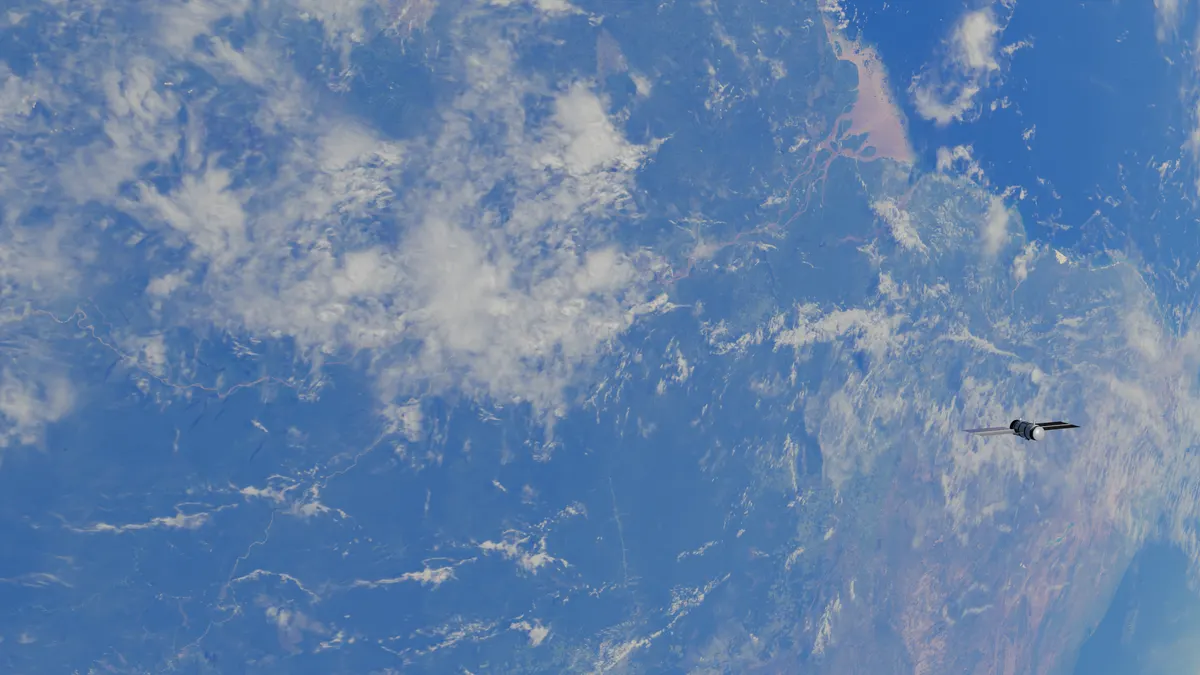
Starlink thermosphere density research has produced something its engineers almost certainly never planned for: a genuine scientific instrument, distributed across hundreds of low-Earth orbit satellites, quietly measuring one of the least-understood layers of our atmosphere. Two recent papers have now demonstrated that the ephemeris data SpaceX publishes for its Starlink constellation can be used to reconstruct the density of the thermosphere with a resolution comparable to that of dedicated scientific spacecraft.
A Broadcast Signal Turned into a Scientific Dataset
SpaceX has been publishing near-real-time orbital data for individual Starlink satellites since 2021, primarily so that astronomers and satellite operators can track where the spacecraft actually are. Each data point records position and velocity precisely enough that, if you know those values over time, you can work backwards and infer the atmospheric drag the satellite experienced, and from drag, density. The thermosphere, which sits above roughly 100 km altitude and below the exosphere, is the region in question. Its thickness and density fluctuate with solar irradiation, which shifts the exact altitude at which the exosphere begins; the upper boundary generally lies well above 600 km. Both the International Space Station and China’s Tiangong station orbit within the thermosphere, as do the Starlink satellites themselves.
In a 2025 paper published in Remote Sensing, Zhuoliang Ou and colleagues used this Starlink ephemeris data to investigate thermospheric structure and established that results matched well with those from SWARM-B, a dedicated research satellite. That was an encouraging proof of concept, but the methodology still followed relatively conventional lines.
Starlink Thermosphere Density Research Goes Tomographic
The work by Mamoru Yamamoto takes the approach considerably further. Rather than using a standard two-line element set, the workhorse format of orbital mechanics, essentially a compact summary of a satellite’s trajectory, Yamamoto applied a tomographic method that draws on a much larger volume of data to reconstruct a fuller picture of the atmosphere. The analogy to medical tomography is apt: instead of a single profile through the body, you are building a three-dimensional reconstruction from many different angles and passes.
According to Phys.org, the technique allowed the team to construct a two-dimensional latitude-longitude snapshot of thermospheric density at an altitude of approximately 500 kilometres. The findings are published in the journal Earth, Planets and Space, and the result is described as the first tomographic analysis of its kind. Crucially, it demonstrates strong agreement with observations from the European Space Agency‘s SWARM mission, which measures density variations along satellite trajectories, a meaningful validation given that SWARM was purpose-built for exactly this kind of geophysical measurement.
The claimed resolution sits roughly on a par with the SWARM satellites themselves. That is a considerable achievement for a dataset derived from broadband internet infrastructure rather than a science mission with a dedicated instrument suite, a carefully chosen orbit, and years of calibration work behind it.
What This Means for Atmospheric Science
The thermosphere has always been awkward to study. It is too high for weather balloons and research aircraft, and too low for most operational satellites to maintain a stable orbit for long. Dedicated low-perigee spacecraft like the SWARM constellation provide invaluable data, but the constellation is small and the coverage is limited. Starlink, by contrast, fields hundreds of satellites across a wide range of inclinations, providing a density of sampling that no single scientific programme could realistically fund.
With Starlink ephemeris data available since 2021, researchers already have several years of continuous records to work through, covering periods of varying solar activity. Solar irradiation is a primary driver of thermospheric expansion and contraction, so a multi-year dataset spanning different phases of the solar cycle is exactly what atmospheric physicists need to characterise long-term variability.
The Ou et al. paper in Remote Sensing established that the data source was credible. Yamamoto’s tomographic work, now published in Earth, Planets and Space, suggests the ceiling may be higher still, that with the right analytical methods, a constellation designed to stream video across remote farmland may have accidentally become one of the most productive atmospheric observatories ever assembled. The first tomographic map of thermospheric density from Starlink data is a result that dedicated atmospheric scientists, working with far smaller budgets and far fewer satellites, would have found extremely difficult to produce any other way.
