


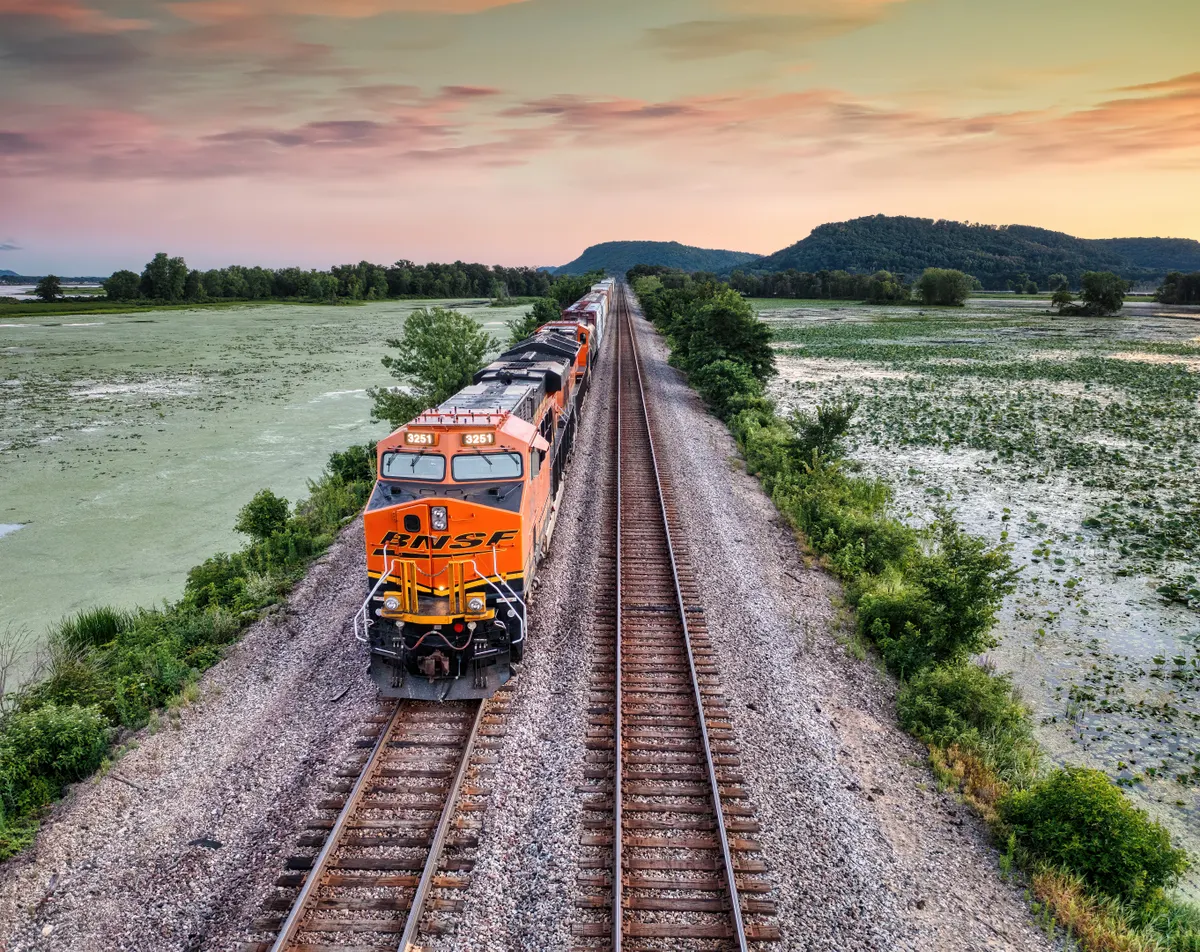
Linear scanner panoramic photography has been taken to a genuinely new extreme by a creator known as [Philo], who built a working camera system around an industrial single-line sensor and used trains, boats, and other moving vehicles as the dolly track.
From Smartphone Prototype to Industrial Sensor
The project began modestly enough. A smartphone camera was placed on a chair and slowly rotated around a room. Custom software captured a single column of pixels during each incremental movement, then stitched those columns together into one continuous image. It worked well enough to encourage further development, and [Philo] refined the approach through several iterations.
The real leap came when a purpose-built single-line digital camera, the kind designed for imaging assembly lines and conveyor belts in industrial settings, entered the picture. That sort of sensor captures exactly one row of pixels at a time, which is precisely what this technique demands. Pressed into service for panoramic photography rather than quality-control inspection, it turned out to be a considerably more capable tool than any repurposed smartphone.
Linear scanner panoramic photography works on the same principle as a drum scanner or a flatbed’s moving head: build the image one vertical slice at a time, then assemble the slices in sequence. The difference here is that the camera moves through real-world space rather than across a static original, which means the ‘document’ being scanned is the entire landscape surrounding the track.
Railways, Rivers, and the Stabilisation Problem
With the industrial sensor in hand, [Philo] began mounting the rig on whatever offered a long, reasonably smooth traverse: railways and boats feature prominently in the results. The motion of the vehicle provides the scanning movement, and accelerometer data is fed into the software to help compensate for vibration and sway during the capture.
The results, even with that compensation in place, carry a noticeable wobble. Vehicles are not precision linear stages, and the sensor was never designed to be carried through countryside at speed. Yet the images produced are among the longest panoramic photographs achievable with a digital capture system, and the wobble reads as texture rather than failure once you are looking at a single unbroken frame stretching across an entire rail journey or waterway.
It is worth pausing on where the sensor comes from. A camera built to check whether bottles are correctly filled or circuit boards correctly populated has a very specific set of design priorities: speed, consistency, and the ability to detect fine defects on a fast-moving line. Dynamic range and colour rendition for pictorial photography are not on that list. That [Philo] coaxed landscape panoramas out of such a device is a fair demonstration of what happens when you ignore what a tool was made for and concentrate on what it physically does.
The software side of the project is doing significant work throughout. Grabbing a single pixel column per frame, correcting for the accelerometer readings, stitching thousands of those columns into a coherent image, and managing the distortion that comes from uneven vehicle speed all require careful implementation. A naive stitch produces smearing and compression artefacts; the refined version produces images that hold together over their full, considerable length.
For those who prefer light on silver halide, panoramic film cameras remain available, and the report acknowledges them directly. Film-based panoramic systems have their own character, particularly in tonal rendering and grain structure, but they cannot match the sheer length achievable when a digital sensor is carried along a railway line for minutes at a time. The two approaches are solving related problems with rather different toolkits.
Linear scanner panoramic photography of this kind sits at an unusual intersection: industrial machine vision hardware, custom software development, and the very old idea of moving a camera steadily past a scene. [Philo]’s project is a proof of concept that has already produced usable, arresting images, and the logical next step is finding smoother transport and a sensor with a wider dynamic range.
