


A Saturn’s rings femtosatellite mission that would launch 10,000 tiny probes into one of the solar system’s most hostile environments has received funding consideration through NASA‘s Innovative Advanced Concepts (NIAC) Programme for 2026, with the proposal coming from Dr Michael Rubenstein of Northwestern University.
The concept is called ‘Actively Steerable Femtosat Constellations for In-situ Exploration of Saturn’s Rings, Atmosphere, and Magnetosphere’, and it is exactly as audacious as that title suggests. Rather than sending a single, enormously expensive spacecraft into the rings and hoping for the best, Rubenstein’s proposal embraces a fundamentally different philosophy: send so many probes that survival, somewhere in the swarm, becomes a near-certainty.
A Sea Turtle Strategy for Saturn’s Rings Femtosatellite Concept
Saturn’s rings are not a welcoming place for hardware. Dust, debris, and ice fragments of every conceivable size make the region almost certain death for a conventional spacecraft. The logic behind flooding that environment with 10,000 femtosatellites, each tiny enough to make a modern cubesat look positively grand, is that the odds flip. Where one probe almost certainly dies, a constellation of thousands almost certainly delivers at least some science back home.
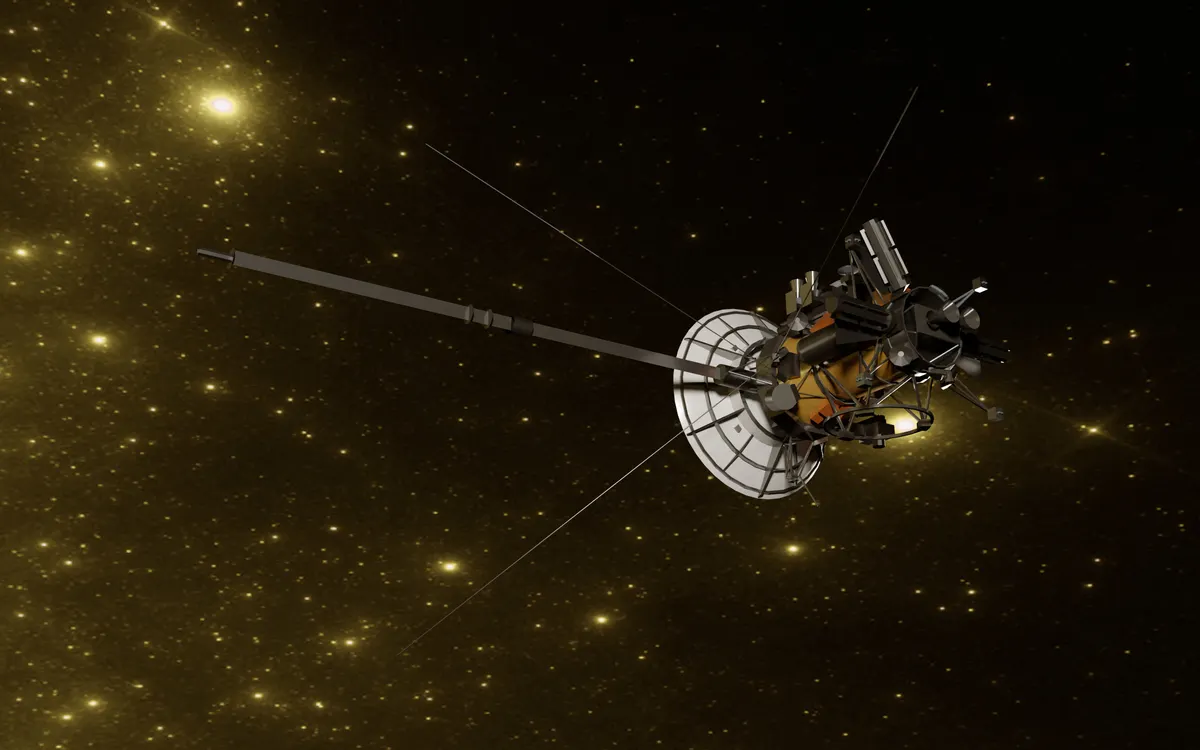
It is a philosophy ecologists would recognise. A K-selected species, the elephant say, pours everything into a single offspring and guards it ferociously. NASA’s Cassini mission to Saturn was precisely that: a flagship probe representing years of development and enormous cost, handled accordingly. The r-selected alternative, the sea turtle leaving hundreds of eggs on the beach and trusting probability, is what Rubenstein is now proposing for the next generation of ring science. Cassini would never have been thrown into the rings. Femtosatellites, by design, can be.
The femtosatellites in question sit below even the picosatellite class. Where cubesats, themselves only a decade or two from novelty status, weigh in at grams to kilograms, femtosatellites are smaller still. The idea that a constellation of 10,000 of them could collectively map Saturn’s rings, sample its atmosphere, and probe its magnetosphere is the kind of proposal that only starts making sense when you accept that individual loss is built into the mission architecture from day one.
What the NIAC Phase I Award Actually Means
It is worth being clear about what this funding stage represents. As Overlook Horizon reports, NIAC Phase I awards provide up to $175,000 for a nine-month initial investigation, and the 18 projects selected in 2026 share a total pot of $3.2 million across the programme. These are early-stage concept studies, and NIAC is explicit that its projects are not considered official NASA missions. Rubenstein’s femtosat constellation is, at this point, a funded idea being rigorously examined, not a spacecraft on an assembly line.
That framing matters. NIAC exists precisely to give breathing room to concepts that would be laughed out of a conventional mission proposal, and a Saturn’s rings femtosatellite mission involving 10,000 expendable probes is exactly the sort of thinking the programme was designed to incubate. Some of the most consequential space hardware has roots in similarly outlandish-sounding NIAC studies.
Dr Rubenstein discussed the project in detail on a podcast alongside Fraser Cain, which surfaced via a community tip from Richard HT. The conversation covers considerably more technical ground than NASA’s official programme page, for anyone wanting to go deeper on the steerable constellation mechanics and the data-recovery architecture that would make any of this scientifically useful.
The nine-month Phase I study will now begin working through whether the concept holds together under scrutiny. If it does, a Phase II proposal could follow, and a Saturn ring-diving swarm of femtosatellites would move from intriguing idea to something rather more serious.
