


The question of whether you have a fully characterised system sits at the heart of engineering discipline, but as anyone who has spent time in a hackerspace will tell you, the honest answer is usually no, and the project works anyway. That tension between rigorous characterisation and pragmatic workaround is worth examining, because the hose in your front garden does not care about your theoretical model.
The Professor’s Question, and the Hackerspace Answer
The phrase came from a professor at a graduate electrical engineering programme, filtered through a friend who used to frequent the same hackerspace. Whenever a student project went wrong, the professor’s response was consistent: ‘Have you fully characterised the system?’ It is a sound diagnostic instinct. It also became an internal joke, because the hackerspace’s operating mode was closer to YOLO about 95 per cent of the time. Head crashes on the 3D printer? Not fully characterised. Forgot to take the rubbish out? The system was not fully characterised. The joke holds because the gap between theory and practice is real: in theory, all systems can be fully characterised; in practice, you cannot fully characterise what you do not yet fully understand.
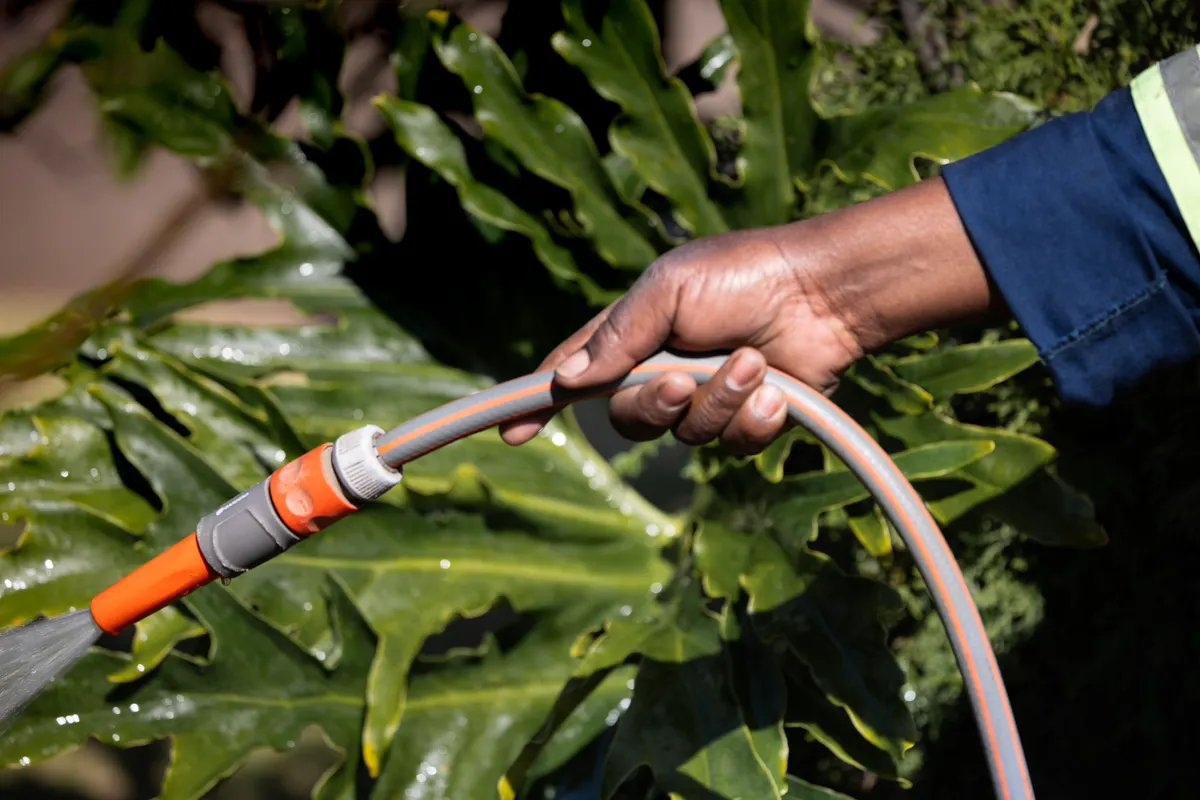
The irrigation project illustrates the point cleanly. Nine small saplings in the front yard need watering. Moving a hose from tree to tree is tedious, so the logical approach is to take a length of hose, stopper one end, drill enough holes along it, and irrigate all nine at once. Some characterisation did happen: the flow rate per minute through the hose was measured, the outflow divided up mentally, and holes were drilled accordingly. The holes turned out to be far too large, and the water poured from the first few while the last few stayed dry.
The reason is straightforward once you see it. A length of hose has resistance to flow. The system is not constant-pressure along its length, and the drag inside the hose matters enough to drop the pressure significantly before the water reaches the downstream end. Because that resistance was never considered a variable worth measuring, it was never measured. The fully characterised system had a gap, and the gap was the most important part.
Avoiding Characterisation as a Design Strategy
The retrospective fix is instructive. Professional drip irrigation systems use holes that are tiny relative to the pipe diameter. At that scale, the pressure drop across each hole dominates the pressure drop along the pipe, so the variation in pipe pressure along the run barely matters. The designer sidesteps the characterisation problem entirely by making the thing they cannot easily measure irrelevant to the outcome.
That is what worked here, too. Cutting the hole size in half, then gradually widening the downstream holes until the distribution looked roughly even, produced a working system. Not a fully characterised one, but a working one. The holey chunk of hose that resulted from the first attempt is in the bin. The saplings are watered.
So alongside the engineer’s ‘have you fully characterised the system?’ sits the hacker’s complementary question: ‘Can you avoid characterising parts of the system?’ Design around the unknown variable rather than measuring it. It is a different kind of rigour, and it has a long, productive history in the kind of thinking that gets things done in a weekend.
Supercon Ten: Tickets on Sale Now
On a separate note for anyone who builds things and sometimes ignores the characterisation step: Hackaday has announced that Supercon Ten tickets are on sale now, with the call for participation extended by a further two weeks. The event takes place 6–8 November in Pasadena, CA. Early bird tickets are priced at $150, compared with the regular price of $296 plus fees, a meaningful saving if you move quickly.
This piece is drawn from the Hackaday newsletter, which lands every Friday and has run for more than 200 consecutive weeks. If a community of people who water trees with drilled hose and ask hard questions about system characterisation sounds like your crowd, the Hackaday community and its annual gathering are the natural next step.
